
Moringa leaf supplement :-Moringa oleifera leaves are rich in nutrients and bioactive compounds.
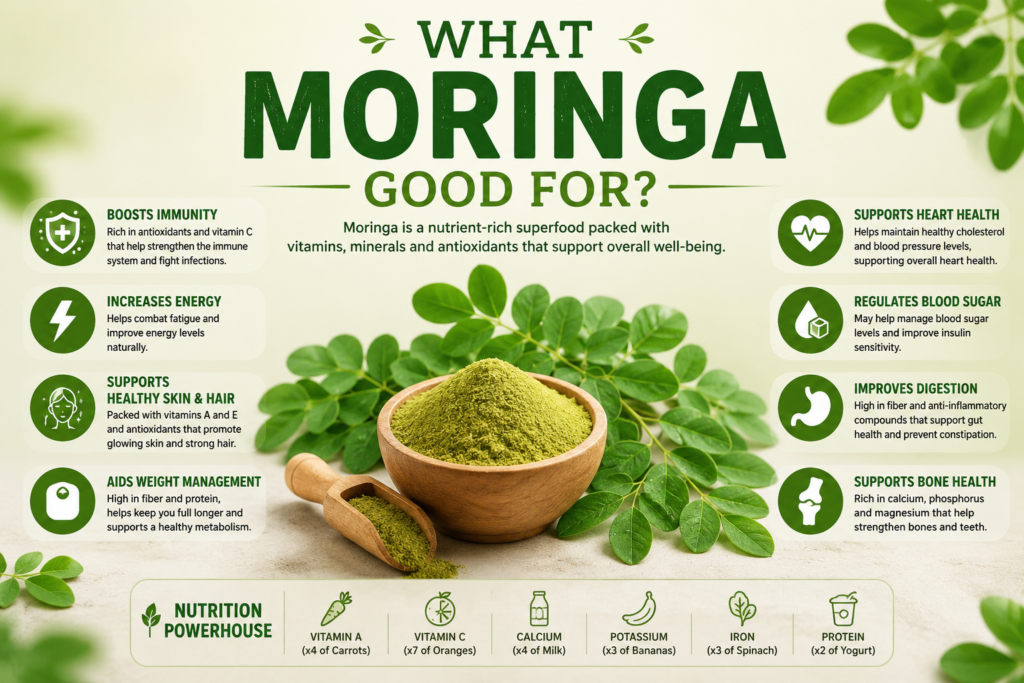
When considering nutritional value, they are rich in calcium, iron, potassium, vitamin A, vitamin C, and vitamin B (B1, B2, and B3).
Furthermore, they also contain all nine essential amino acids, which are necessary for muscles and the immune system. Additionally, these leaves contain bioactive compounds such as flavonoids, phenolic acids, isothiocyanates, and carotenoids.
All these compounds can play a role in fulfilling nutritional requirements as well as managing several diseases.
1. Nutritional value of moringa
In developing countries and rural areas, nutritional deficiency is a major cause of various disorders that, if not treated properly, may lead to adverse outcomes in individuals including death.
Because of a lack of knowledge and resources, the people living in such areas remain without nutritionally rich food.
Indigenous plant species that are nutrient-dense can play a vital role in fulfilling nutritional requirements in these areas.
Moringa oleifera is one such plant that is rich in nutrients and bioactive compounds.
Urbain Zongo and colleagues conducted a study on Moringa oleifera leaf powder and its efficacy in enhancing young children’s nutritional status and retinol concentrations.
The researchers randomly selected 119 preschool children and divided them into experimental and control groups. The volunteers consumed moringa leaf powder for about 12 weeks.
The control group received a regular diet, while the experimental group received 30 g of moringa leaf powder along with daily meals.
Parameters such as weight, height, and serum retinol concentrations were observed before and after the study.
The study demonstrated that Moringa oleifera leaf powder showed beneficial effects when used as a supportive treatment in young children.
2. Moringa and cholesterol – Can moringa lower cholesterol?
Hyperlipidemia is a disorder in which there are increased lipid levels, including cholesterol and triglyceride levels in the blood.
Increased LDL levels cause blockage in arteries, while increased HDL levels prevent artery blockage.
This disorder may occur due to factors including daily dietary habits, genetics, and diseases such as diabetes, hypothyroidism, and renal dysfunction.
Its consequences include heart disease and pancreatitis.
It can be managed by a change in lifestyle and, if needed, standard medical interventions.
Conventional medicines have several side effects alongside beneficial effects.
Indigenous plants such as moringa can be used along with conventional medicaments for management of hyperlipidemia.
Moringa is a rich source of antioxidants, polyphenols, and carotenoids, which may help in the management of hyperlipidemia.
Vanisha S. Nambiar and colleagues evaluated the efficacy of Moringa oleifera leaf tablets in the management of hyperlipidemia.
The researchers randomly selected 20 hyperlipidemic volunteers and divided them into experimental and control groups.
They measured biochemical parameters before and after the study.
The experimental group received 8 tablets of 575 mg per day for about 50 days, which equals 4.6 g of moringa leaf powder, while the control group did not receive it.
The study demonstrated that dehydrated Moringa oleifera leaf powder tablets showed a beneficial effect on cholesterol levels, increasing HDL levels while decreasing LDL levels.
3. Moringa for immune system – What does moringa do?
To understand the role of moringa in boosting immunity, we first need to have a clear idea of how the immune system functions. It is called the body’s defense system. The immune system has to play a role in combating various infections and diseases that are caused by infectious microorganisms and other toxins. It helps in the destruction of microorganisms and to eliminate damaged cells. It also plays a role in repairing tissue. There are two types of immune system mechanisms to defend against foreign entities.
- The innate immune system is one where skin, mucous membranes, and macrophages play a role in the body’s defense mechanism. It is a primary defense mechanism.
- The adaptive immune system is one where lymphocytes, which include T cells and B cells, produce antibodies to combat against invasive foreign bodies.
Although conventional medicine has beneficial immunomodulators, they are often associated with several side effects.
Indigenous plants, such as moringa, may act as natural immunostimulants due to the presence of nutrients and bioactive compounds.
Indriya Rachmawati and colleagues studied the effect of administration of moringa oleifera leaf extract on CD4+, CD8+, and B220+ in Mus musculus mice.
For the study, researchers isolated lymphocyte cells and placed them into culture medium.
The experimental group of cells received varied concentrations of moringa leaf extract, while the control group did not receive it.
The researchers demonstrated the immunostimulant properties of Moringa oleifera extract on enhancing the count of CD4+ and CD8+ helper T cells.
4. Moringa leaf powder benefits: in nutritional deficiency
Nutritional deficiency is a critical issue for school-going children when they do not consume an adequate, nutrient-rich diet.
It leads to physical and mental health-related problems among children.
Although standard medical intervention can be used for the management of the condition, it may also have several side effects.
Plant-based dietary supplements can have the potential to manage such deficiencies.
When considering herbal remedies, Moringa oleifera is nutrient-dense and can serve as a rich source of nutrients to fulfill deficiencies.
Moringa oleifera leaves can be used as a complementary supplementary diet.
M.E. Seraficoa et al. evaluated the efficacy of Moringa oleifera leaf powder among schoolchildren targeting iron, vitamin A, and folic acid deficiencies.
For the study, researchers randomly assigned 121 underweight children aged between 8 and 10 years. They divided these children into control and experimental groups.
The control group received a regular diet, while the experimental group received a regular diet supplemented with 3 grams of moringa powder.
They measured various physical parameters such as children’s height and weight, as well as biochemical markers to evaluate the efficacy of Moringa oleifera leaf powder.
The study was conducted for about 120 days. Researchers demonstrated that daily Moringa oleifera powder consumption effectively restores reduced iron, vitamin A, and folic acid levels in children.
References:
1) Zongo U, Savadogo A, Dicko MH, et al. Effect of moringa leaves powder consumption on young children nutritional and serum retinol status in Burkina. Int J Nutr Food Sci. 2018;7(4):148-154.
2. Nambiar VS, Guin P, Parnami S, Daniel M. Impact of antioxidants from drumstick leaves on the Lipid profile of hyperlipidemics. J Herb Med Toxicol. 2010;4(1):165-172.
3) Rachmawati I, Rifa’i M. In vitro immunomodulatory activity of aqueous extract of Moringa oleifera Lam. leaf to the CD4+, CD8+, and B220+ cells in Mus musculus. J Exp Life Sci. 2014;4(1):15-20.
4. Serafico ME, Perlas LA, Magsadia CR, Desnacido JA, Viajar RV, Rongavilla EO, et al. Efficacy of Malunggay (Moringa oleifera) leaves in improving the iron and vitamins A and B status of Filipino schoolchildren. Acta Hortic. 2017;1158:293-302.
Faq
Moringa oleifera should not be used as an alternative to standard medication but can be used as supportive treatment in the management of hyperlipidemia. As an herbal remedy, Moringa oleifera has minimal side effects when consumed daily in adequate quantities. It is possible that moringa may interact with conventional antihyperlipidemic medication. Therefore, always consult a healthcare provider before starting moringa consumption for information regarding possible interactions, side effects, and dosage to be administered for beneficial effects.
Yes, as an herbal supplement, moringa can be consumed daily for extended periods to help in the management of hyperlipidemia.
Yes, antioxidants and flavonoids present in moringa leaves may have a beneficial effect in reducing LDL levels, serving as a supportive medication.
Antioxidants and flavonoids present in moringa leaves may have a beneficial effect in reducing LDL levels, serving as a supportive dietary supplement.
Scientific studies conducted around the world demonstrate that moringa may elevate HDL levels. Bioactive components present in its leaves may play a key role in enhancing these levels.
Kaempferol, quercetin, isothiocyanates, and chlorogenic acids present in Moringa oleifera may play a role in the management of hyperlipidemia by acting through distinct mechanisms.
The recommended dosage of Moringa oleifera varies from individual to individual. It depends on a person’s biochemical profile, physical status, and whether the person is currently consuming any conventional medications.
Moringa supplements formulated from leaves are considered the best for the management of hyperlipidemia. They may be consumed as powders, capsules, tablets, or extracts. The bioactive compounds present in leaves help to manage hyperlipidemia
It takes about 1 to 3 months for beneficial effects of moringa on cholesterol. Daily consumption is key for achieving adequate efficacy.
Yes, it is possible to consume moringa alongside standard cholesterol-reducing medications. However, it can cause interactions with some medications. There are chances of an additive or antagonistic effect when both are consumed together. To avoid potential interactions, you should consume moringa at least 1 to 2 hours after taking conventional medications. Always consult your healthcare provider before adding it to the diet.
To fulfill their daily nutritional requirements, vegetarians must consume a variety of plant-based foods such as legumes, nuts and seeds. Among these foods, moringa is a rich source of several nutrients. These nutrients are present in abundant quantities compared to other plant-based foods. Therefore, Moringa oleifera leaves and their powder can be used in the diet to fulfill daily nutritional demands.
Yes, clinical studies conducted on Moringa oleifera demonstrate the effectiveness of this plant as a supportive supplemental food for the management of protein-energy malnutrition.
Yes, Moringa oleifera leaves possess abundant amounts of vitamin A, iron, vitamin C and calcium. Therefore, they can be utilized to manage these micronutrient deficiencies
Yes, clinical studies demonstrate the effectiveness of Moringa oleifera in managing nutritional deficiencies in these populations. Consuming Moringa oleifera leaves and leaf powder in adequate quantities has a beneficial effect with minimal side effects in infants, children, pregnant women, and breastfeeding mothers. However, always consult a healthcare professional before consuming it. Furthermore, it must be avoided in infants under six months of age.
Although Moringa oleifera is a herbal remedy, it can cause certain side effects and interactions with other medicines employed in malnutrition management. It should be consumed carefully by persons already suffering from a disease and undergoing standard medical treatment interventions. Furthermore, sensitivity and allergic conditions should be monitored by a healthcare provider while consuming moringa. Moringa leaves and leaf powder are considered safe, while other plant parts may cause adverse health effects.
Yes, clinical studies reveal the efficacy of Moringa oleifera in improving hemoglobin levels and managing anemia associated with malnutrition.
Yes, Moringa oleifera may interact with several medications employed in the management of liver, kidney, heart, and thyroid diseases. It may also interact with other nutritional supplements, leading to enhanced nutrient levels and ultimately to adverse effects.

Mr.Piyush D Sadar ,Mpharma B pharma ,Pharma Blog Writer
Medical Disclaimer: This article is for educational purposes only and should not replace professional medical advice. Always consult your obstetrician or healthcare provider before using moringa or any herbal supplement during pregnancy.