
Moringa Leaf During pregnancy, a mother’s daily nutrient needs increase compared to non-pregnant women because the fetus also needs nutrients for growth and development.
Furthermore, it is possible that mothers may suffer from various common disorders during pregnancy.
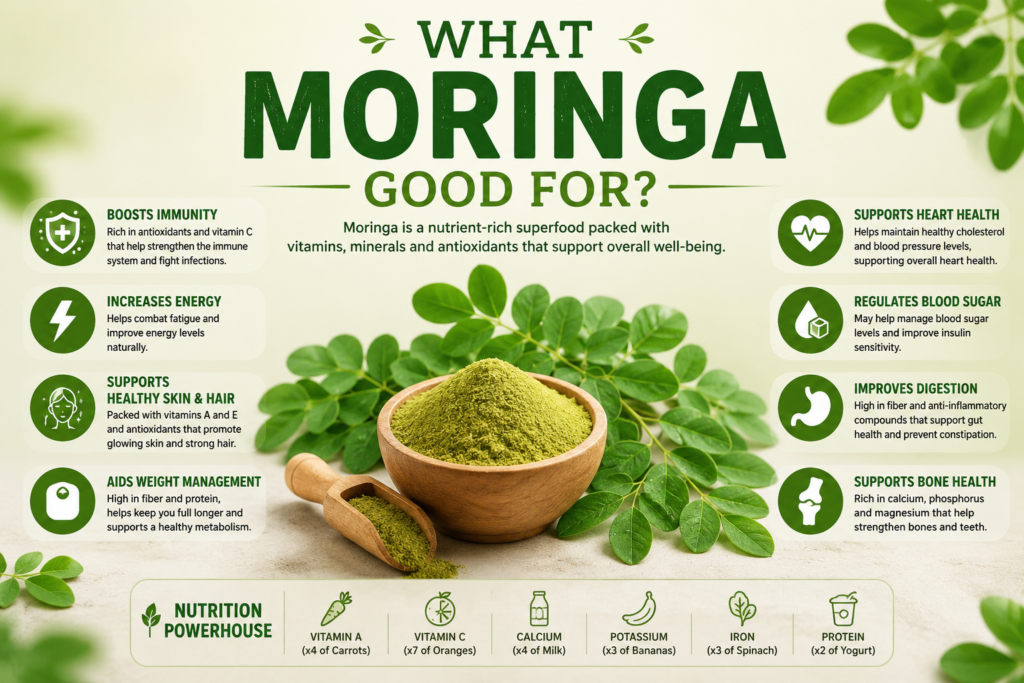
Therefore, a proper nutrient-rich diet is vital for pregnant women. Among the plant-based food sources, moringa is one that is rich in various micronutrients and macronutrients and hence can be helpful to fulfill daily requirements.
Moringa also possesses bioactive compounds besides nutrients that play a role in the management of various disease conditions.
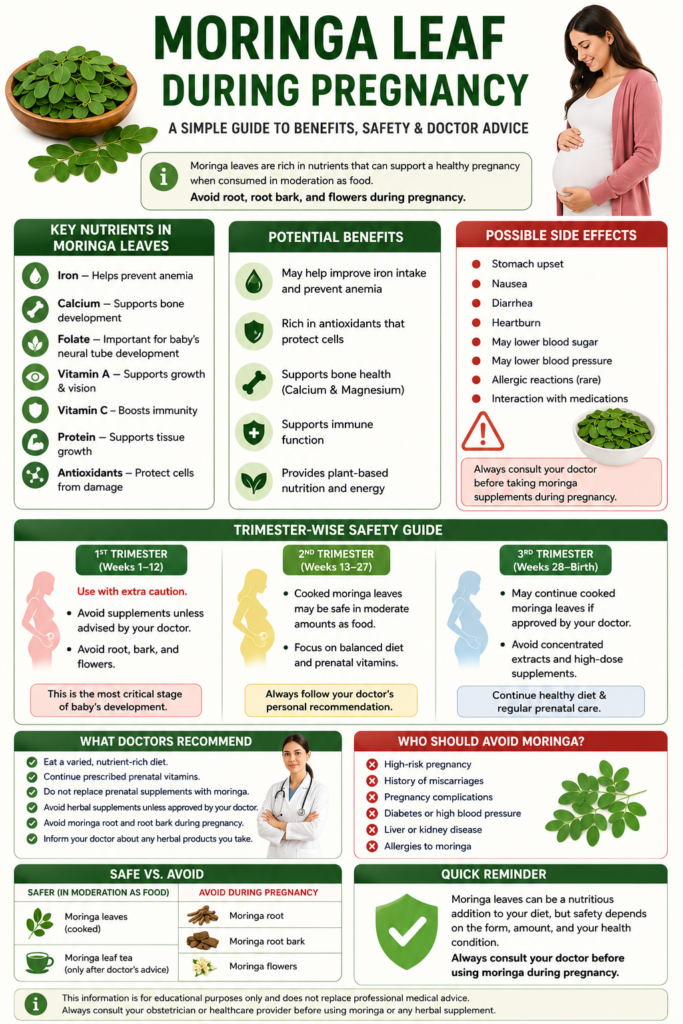
However, it is necessary to consume moringa carefully and under medical supervision during pregnancy.
Moringa leaf And Pregnancy
Extensive studies have been conducted worldwide to investigate the efficacy of moringa leaf during pregnancy. Some of the studies are summarized below.
1. Moringa for pregnant
Anemia is a common disorder that affects many women during and after pregnancy all over the world, both in developed and developing countries.
According to the WHO, when a woman’s hemoglobin level is less than 10 g/dL after the first week postpartum, the condition is known as postpartum anemia.
It is primarily caused by untreated iron deficiency during pregnancy or excessive blood loss after childbirth. If not managed in a timely and proper manner, it may lead to maternal mortality.
During pregnancy, iron demand increases enormously because of an increase in the erythropoiesis process. It is a process of RBC production by the human body, and iron is required for RBCs, so it ultimately leads to an increased demand for iron.
The iron need reaches approximately 1,000 mg during the pregnancy period, as the fetus also needs it. As in anemia, there is a decrease in hemoglobin levels; it ultimately reduces oxygen-carrying capacity, and an inadequate concentration of oxygen leads to alterations in the physical and mental health of mothers.
Its adverse effects include dizziness, palpitations, and weakness. It is necessary to manage the condition with standard conventional medications and daily intake of an iron-rich diet.
Iron tablets and standard conventional medications can be utilized to manage the anemia, but they also possess side effects. In remote areas and undeveloped regions, these medications may not be accessible to the people due to lack of awareness and the high cost of medication.
Therefore, an alternative to correct iron deficiency is needed in such regions. In Ayurvedic systems of medicine, moringa is one such alternative, which is full of macro- and micro-nutrients.
Arum Estiyani et al. conducted an investigation into the efficacy of Moringa oleifera leaves on the blood profile of postpartum mothers.
The researchers utilized a pre-test and post-test model to evaluate the efficacy of Moringa oleifera.
The complete blood profile was determined before and after moringa utilization.
They randomly selected approximately 30 postpartum mothers aged 20 to 35 and divided these mothers into experimental and control groups.
These mothers were not taking any herbal medications before or during intervention.
Both groups were given different treatments: the experimental group consumed Moringa oleifera capsules and iron tablets, while the control group ingested only standard conventional iron tablets for about 14 days.
It was found that the group of mothers that consumed moringa capsules and iron tablets together demonstrated notable enhancement in hemoglobin, hematocrit, erythrocytes, thrombocytes, and other blood profiles.
2. Moringa during pregnancy
Since ancient times, there have been various methods available to prevent pregnancy. Although these methods are effective, they have certain side effects and are not utilized by all.
A large segment of the global population resides in rural and developing areas and is unable to utilize them.
Furthermore, to manage or end an unwanted pregnancy, conventional medicinal treatments are available.
They also have certain side effects. In Ayurvedic medicine, moringa is one such plant with a wide variety of bioactive compounds and can be used as an effective abortifacient.
Ekhator C. N. et al. investigated the abortifacient potential of Moringa oleifera leaves in female Wistar rats. For the study, researchers randomly selected 10 female rats.
For the abortifacient efficacy study, female rats were divided into experimental and control groups.
They were fed a healthy diet. The researchers fed Moringa oleifera leaves to the rats after confirmation of pregnancy.
To evaluate the effect of moringa leaves on rats, the body weights of the female rats were monitored. Researchers found that experimental groups showed a decrease in weight, which indicated pregnancy termination.
3. Moringa and breastfeeding
During the postpartum period, newborns up to six months old entirely depend on their mothers’ breast milk for their nutritional needs.
If a mother has insufficient breast milk production, the infant may not receive adequate nutrients required for growth.
Moringa oleifera is a plant-based food that is nutrient-dense and also has bioactive compounds.
The bioactive compounds in moringa may act as a natural galactagogue to increase nutrient-rich milk volume.
Suzanna L. Attia, George J. Fuchs III, et al. investigated the efficacy of Moringa oleifera leaves on mothers’ breast milk production.
For the study, researchers randomly selected 50 pairs of mothers and infants, dividing them into control and experimental groups.
Experimental group mothers ingested Moringa oleifera powder in their daily diet for about three months.
It was observed that moringa consumption can increase mothers’ milk output and the health of infants without any side effects, according to the determination of various biochemical parameters.
4. Moringa benefits pregnancy
Pregnant women often suffer from anemia. It is a condition where the hemoglobin level decreases drastically. It is caused primarily by iron deficiency, and moringa is a rich source of iron.
Therefore, researchers studied the effect of moringa consumption on iron levels.
Joyce M. Laiskodat et al. investigated the efficacy of Moringa oleifera in the improvement of hemoglobin levels in pregnancy.
For the study, researchers randomly selected 32 pregnant women with a pre-existing anemic condition. The volunteers were grouped as the experimental and control groups.
The effect of daily consumption of moringa leaf soup was studied on pregnant women during the third trimester.
It was observed that moringa consumption showed a notable increase in hemoglobin levels in pregnant anemic women.
Therefore, it can be concluded that moringa had a beneficial effect on managing anemic conditions in the third trimester of pregnancy.
FAQ
There are three trimesters during the pregnancy that cover growth and development stages of the fetus. Moringa oleifera is highly rich in various macronutrients and micronutrients. Besides nutrients, it is also rich in various medicinally important bioactive compounds. These include alkaloids, glycosides, tannins, and saponins. All these bioactive compounds are distributed in varying amounts in all the parts of moringa. The first trimester is a stage of initial growth and development of the fetus.
During the first trimester women must not consume stems, flowers, seeds, pods, leaves, roots, bark, and their commercially marketed formulations. They can consume fresh leaves, leaf powder, and its pure commercial formulations during the second and third trimesters of pregnancy only after consultation with health care professionals. All other moringa parts and their commercial preparations are strictly prohibited throughout pregnancy.
Moringa is rich in calcium, iron, vitamin A, vitamin C, and macronutrients such as protein and carbohydrates. Moringa leaf and leaf-powder consumption during the second and third trimesters has a beneficial effect on maternal and foetal health.
It helps to improve the immune system function of pregnant women.
It can fulfil the mother’s and foetus’ daily nutritional requirements.
It helps to combat pregnancy-induced constipation, as it is rich in dietary fiber.
It also helps to combat iron deficiency anemia, by boosting hemoglobin production.
Moringa oleifera is a very rich source of iron and hence can help to overcome iron deficiency anemia in pregnant women. Iron plays a role in the production of RBCs. An enhancement in hemoglobin leads to an increase in the oxygen-carrying capacity of blood. Consuming moringa leaf powder during the second and third trimesters along with conventional iron tablets has a beneficial effect on anemic conditions.
When we talk about postpartum moringa consumption, we should consider that newborns completely depend on the breastfeeding milk of mothers to fulfill daily nutritional requirements. Moringa is nutrient-dense, and hence, postpartum women can consume it in adequate quantities under medical supervision so it can be beneficial for both mother and newborn.
Yes, numerous clinical studies have found that moringa consumption increases breast-milk volume.
Yes. Clinical studies have observed that consuming parts of moringa oleifera during the first trimester can have abortifacient action.
Each and every woman has a different biochemical, hormonal, and nutritional makeup. Furthermore, genetic, disease-related, and other factors affect it. Thus, the dose of Moringa oleifera varies from individual to individual. Generally, it varies between 500 mg and 1500 mg. So, it is necessary to consult a healthcare professional before consuming moringa and to know the daily recommended dose.
Read more :- what is moringa ?
References
1. Estiyani A, Suwondo A, Rahayu S, Hadisaputro S, Widyawati MN, Susiloretni KA. The effect of Moringa oleifera leaves on change in blood profile in postpartum mothers. Belitung Nursing Journal. 2017 Jun;3(3):191-197.
2. Ekhator CN, Osifo UC. Abortifacient efficacy of Moringa oleifera leaves: an experimental study on adult female Wistar rats. Am J Biol Life Sci. 2015 Dec;3(6):269-72.
4. https://www.who.int/publications/i/item/9789241549585
5. https://www.who.int/tools/elena/interventions/iron-postpartum
6. Attia SL, Owuor PM, Odhiambo SA, Mogaka JN, Ondondo R, Castro Navarro I, et al. Effect of maternal Moringa oleifera leaf supplementation on maternal and infant nutritional status and human milk output: a pilot single-blinded cluster-randomized trial. Curr Dev Nutr. 2025 Jan;9(1):107568.
7. Laiskodat JM, Kundaryanti R, Novelia S. The effect of Moringa oleifera on hemoglobin levels in pregnancy. Nurs Health Sci J. 2021;1(2):136-141.
8. Neef V, Choorapoikayil S, Hof L, Meybohm P, Zacharowski K. Current concepts in postpartum anemia management. Curr Opin Anesthesiol. 2024 Jun 1;37(3):234-238
Auther Name:-

Mr.Piyush D Sadar ,Mpharma B pharma ,Pharma Blog Writer
Medical Disclaimer: This article is for educational purposes only and should not replace professional medical advice. Always consult your obstetrician or healthcare provider before using moringa or any herbal supplement during pregnancy.