
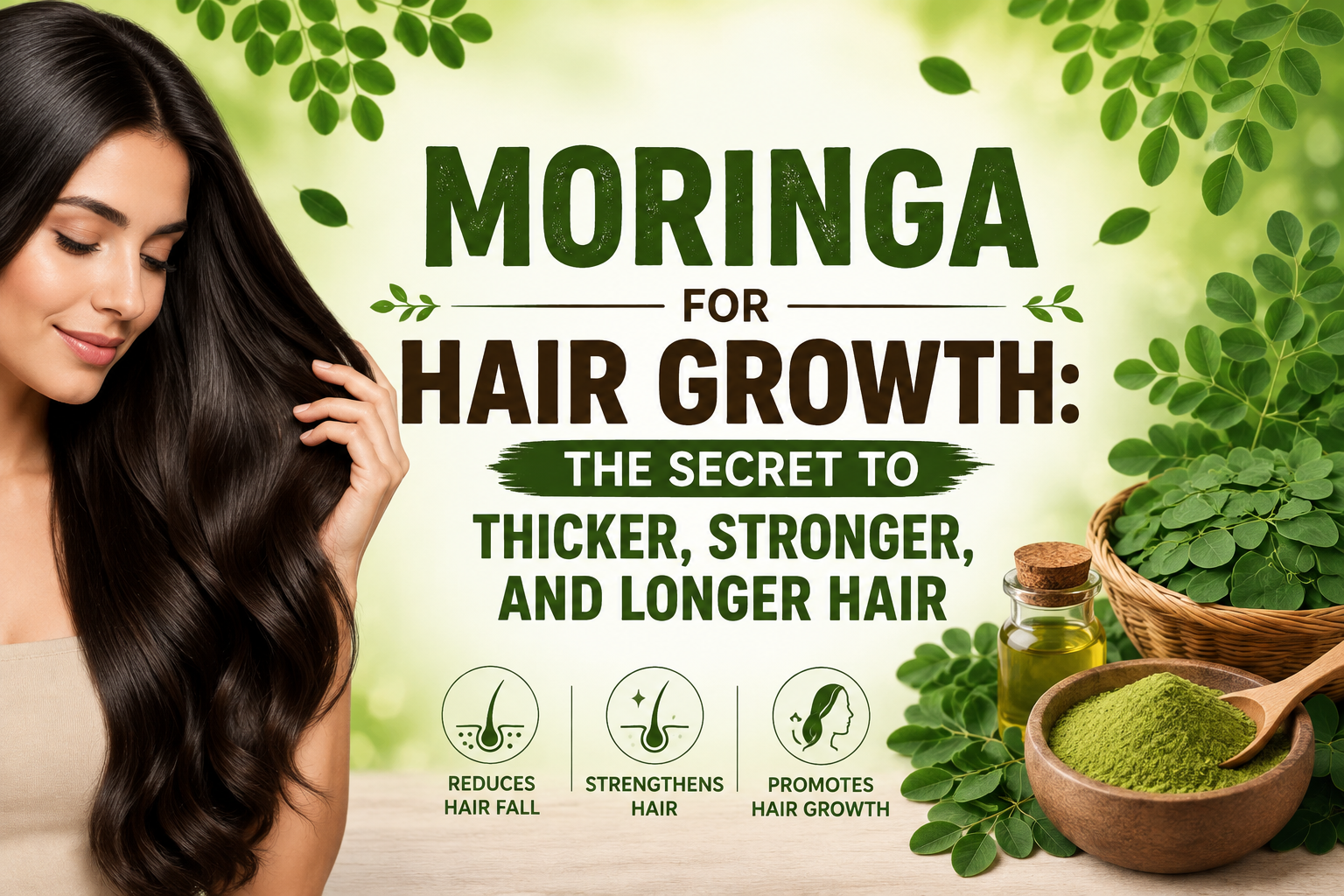
A) Moringa for Hair Growth: The Secret to Thicker, Stronger, and Longer Hair
Moringa oleifera plant parts are rich in various nutrients and substances that are helpful for the management of diseases and also for maintaining normal health status in individuals.
Iron present in it may help the transport of adequate quantities of oxygen. It is essential for normal hair growth and strength.
Moringa possesses zinc, which can play a role in protein synthesis and proper functioning of oil glands.
Antibacterial agents present in it may help combat dandruff and other infections that occur on the scalp.
Antioxidants present in it may help prevent oxidative stress and baldness.
Additionally, vitamins and amino acids present in it play a role in maintaining hair health.
Moringa Benefits for Hair: Can This Superfood Reverse Hair Loss and Thinning?
Alopecia is a medical term for hair loss. It is a common problem that occurs in both men and women.
There are four common types of alopecia: androgenetic alopecia, alopecia areata, traction alopecia, and telogen effluvium.
The condition is caused by various factors such as genetics, hormonal changes, medications, disease, stress, autoimmune conditions, pregnancy, lack of nutrients, and environmental factors.
Conventional medications can be used to manage this condition.
The main drawbacks of this conventional treatment are its side effects, cost of treatment, and unavailability in remote areas.
A wide variety of herbal medicines have been used to treat and prevent diseases since ancient times.
Among these, moringa is one such plant that can help manage alopecia.
Yulius Baki Korassa and colleagues conducted a study on the effect of Moringa oleifera Lam seeds on dihydrotestosterone-induced alopecia in rabbits.
Androgenic alopecia is a very common hair loss condition in men between the ages of 50 and 70 years.
The condition is caused by the presence of the enzyme 5-alpha-reductase.
The product obtained from action of enzyme on testosterone is responsible for decreasing blood flow to the hair follicle ultimately leads to retardation of hair growth, hair damage, and shrinking of hair follicles.
Moringa seed contains substances such as beta-sitosterol and stigmasterol. These compounds may alter the activity of 5-alpha-reductase and ultimately reduce hair loss.
The researchers selected twenty-four New Zealand male rabbits aged 3-4 months and divided them into experimental and control groups.
Alopecia among rabbits was induced by the administration of dihydrotestosterone at a dose of 0.01 gm/0.1 ml for 20 days.
After the appearance of alopecia, moringa seed oil was administered in varied doses to the experimental group for approximately 28 days.
The control group did not receive treatment.
The positive control group of rabbits received treatment of 0.1% of finasteride, and the negative control group received treatment of 1% tween 80.
They observed various parameters, including hair length, hair weight, and thickness.
The findings suggest that 12.5% of moringa seed oil has an optimum activity against alopecia
Moringa Hair Benefits: How This Superfood Stops Hair Loss and Boosts Growth
Hair acts as a protective barrier from environmental particles and other harmful substances, and it also contributes to aesthetic appearance.
Hair baldness is a very common problem among individuals.
Reski Mulia conducted a study on the effect of an ethanolic extract of Moringa oleifera Lam. leaves and fragrant pandan (Pandanus amaryllifolius Roxb.) tonic on hair growth in white rats.
The researchers selected a specified number of rats and divided them into experimental and control groups.
They administered varied concentrations of a combination of these two extracts, as well as individual extracts, to the rats.
The findings suggest that the combination of Moringa oleifera Lam and fragrant pandan shows a more beneficial effect than when administered individually to the rats.
Thicker, Longer Hair: The Miracle of Moringa Oil for Hair Growth
There are a variety of factors that influence the growth of hair in an individual.
These include vascular endothelial growth factor (VEGF), keratinocyte growth factor (KGF), and epidermal growth factor (EGF).
5-Alpha-reductase is a major factor that causes the hair loss by converting testosterone into dihydrotestosterone.
Conventional drugs such as minoxidil and finasteride can be used to treat alopecia.
There are certain disadvantages of these drugs.
Therefore, scientists have been looking for an alternative and complementary medicine to overcome side effects of standard medications.
Herbal remedies such as moringa, can be utilized to manage such conditions.
Jintana Junlatat and colleagues conducted a study on the effect of Moringa oleifera seed oil on genetic expression and hair growth in mice.
The researchers randomly selected approximately 30 five-week-old female C57BL/6 mice and divided them into 6 groups.
The control group did not receive medication. Three experimental groups received Moringa oleifera in varied concentrations.
One group was treated with a vehicle, and one was treated with minoxidil.
The findings suggest that moringa oil shows a similar effect to that of minoxidil.
Moringa oil acts by suppression of TGF-β1 and 5α-reductase type I and II activity in both keratinocytes and dermal papilla cells.
References:
1. Korassa YB, Saptarini NM, Mustarichie R, Hendriani R, Ola ARB, Novicadlitha Y, et al. Anti-alopecia activity of moringa (Moringa oleifera Lamk.) seed oil against dihydrotestosterone-induced rabbits. Int J App Pharm. 2023;15(Sp Iss. 2):19-24.read more
2. Mulia R, Wahyuningsih I, Bachri MS, Mulyaningsih S. Formulation of hair tonic combination of ethanol extracts of moringa oleifera lam leaves and fragrant pandan (Pandanus Amaryllifolius Roxb) and its activity on hair growth in white rats. Medical Sains: Jurnal Ilmiah Kefarmasian. 2024;9(2):463-476.
3. Junlatat J, Sripanidkulchai B. Moringa oleifera seed oil promotes hair growth in mice and modulates the genetic expressions of factors affecting hair growth cycle in skin cell culture. Songklanakarin J Sci Technol. 2022;44(3):817-825.
4. Mahmood KT, Mugal T, Haq IU. Moringa oleifera: a natural gift-A review. J Pharm Sci Res. 2010;2(11):775-781.
5. Sawadadkar NP, Magar SK, Lodhe NA, Gawai AR, Mante AB, Gite AU et al. A short review on medicinal benefits of Moringa oleifera. JETIR. 2025;12(3):h503-h506.
FAQ
Moringa contains nutrients such as vitamins A, C, and B, amino acids, and vitamin E.
Furthermore, it contains bioactive compounds that have anti-inflammatory, antioxidant, and antimicrobial activity.
Therefore, moringa may help nourish hair, reduce hair breakage, and reduce hair fall.
It may also play a role in the management of diseases related to the scalp.
You can use a mixture of moringa, neem, and sidr powder to make strong and healthy hair.
Neem leaves contain antifungal, antibacterial, and anti-inflammatory compounds.
These compounds together may help prevent and manage dandruff and irritation.
Sidr leaves contain saponins, antibacterial, and anti-inflammatory agents. These together may improve hair health.
Moringa is rich in nutrients and bioactive compounds. Therefore, all these herbs together have an additive effect.
You should start with a small quantity of moringa to check for side effects or allergies.
You can consume ½ to 1 teaspoon per day of moringa powder.
If you want to consume it in tablet or capsule form, 1 or 2 tablets or capsules daily can be taken.
Always consult a healthcare professional for proper dosing of moringa.
Vitamin E, C, and other antioxidants present in moringa may help combat oxidative stress.
Iron may support the erythropoiesis process and enhance hemoglobin concentration and ultimately increase the oxygen-carrying capacity of hemoglobin.
Therefore, moringa may play a role in increasing oxygen to the hair follicles, which promotes healthy hair growth.
Herbal medicine, moringa may begins to show effect between 8 to 12 weeks after initiating its regular consumption.
Yes, preclinical studies demonstrate the effectiveness of moringa consumption for healthy and strong hair.
You can combine all of these ingredients to prepare a hair growth oil.
Moringa seed oil contains vitamins E, A, and C. Additionally, it is also rich in saturated and unsaturated fatty acids.
All these ingredients may help nourish skin and hair. You can apply moringa seed oil daily on your face and hair.
Moringa flowers are rich in nutrients such as amino acids, vitamins A, C, and E.
They also contain antioxidants that combat oxidative stress.
Therefore, these flowers may benefit hair by making it strong and healthy.
Moringa is filled with nutrients such as vitamins A, C, E, and B, and iron, zinc, and amino acids that nourish and maintain the health of hair.
Therefore, it is called a superfood for hair.
Moringa may help reduce hair loss caused by nutritional deficiencies. It cannot help to manage hair loss caused by a genetic defect.
Moringa is rich in amino acids, which are necessary for strong hair.
Antioxidants present in it reduce oxidative stress.
Therefore, consuming moringa daily may help reduce hair shedding during seasonal changes.
Moringa contains high levels of antioxidants along with vitamin C, vitamin E, and polyphenols.
These fight free-radical damage that breaks down melanin (hair pigment) cells, helping slow down premature greying.
Moringa cannot restore hair on a bald individual if the follicular cells are dead and inactive.
Nutritional supplements can be provided only to living cells that may repair hair.
Yes. Moringa possesses natural antifungal and antibacterial properties that help soothe scalp irritation, fight Malassezia (the yeast responsible for dandruff), and rebalance scalp oil production.
Yes, it may safe for oily scalp.
It can be utilized as a complementary food for the management of eczema or psoriasis along with conventional medicines.Preclinical data reveal its role as a supplement for the management of such diseases.
There is a rapid decrease in water content in an individual having high-porosity hair.
Saturated and unsaturated fatty acids in moringa may help to maintain water content by locking in hydration.
Yes, moringa may be suitable for people having low-porosity hair.
Its lightweight molecular structure allows for better absorption through tightly bound cuticles compared to heavier alternative oils.
Moringa oil is considered safe for hair treatment when used in the recommended amount. However, it may cause allergic reactions in some people. If it is applied in excessive amounts, it may lead to accumulation of oil on the scalp.
Consuming moringa powder in recommended quantities does not harm an individual, while consuming in excess quantities may have side effects such as bloating and digestive upset.
Pregnant women may apply moringa topically in the form of powder or oil on the hair.
For internal consumption always consult a healthcare professional as it is harmful in the first trimester and should be used cautiously in second and third trimester of the pregnancy.

Mr.Piyush D Sadar ,Mpharma B pharma ,Pharma Blog Writer
Medical Disclaimer: This article is for educational purposes only and should not replace professional medical advice. Always consult your obstetrician or healthcare provider before using moringa or any herbal supplement during pregnancy.
Read More :Moringa And Diabetes