
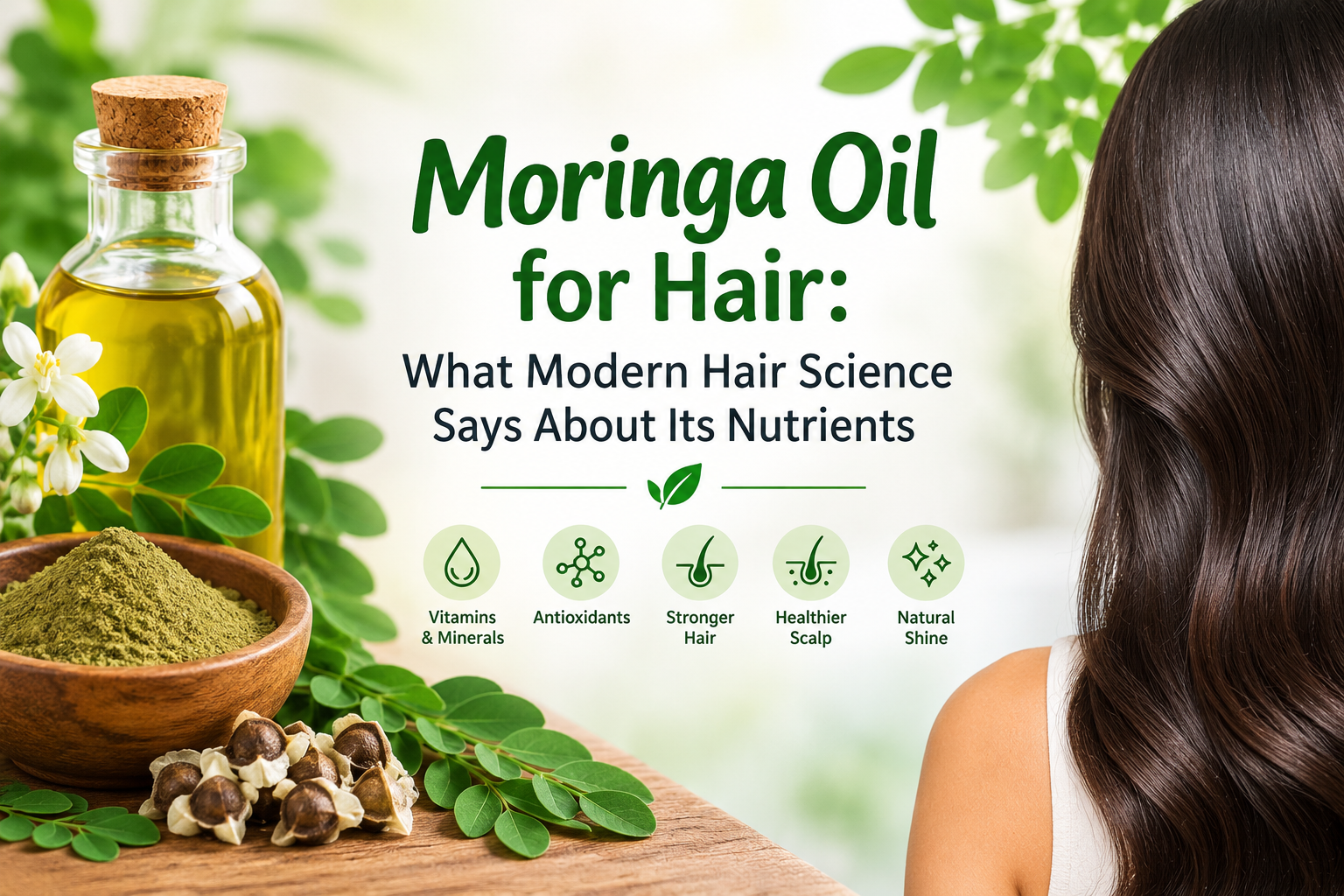
Moringa Oil for Hair: What Modern Hair Science Says About Its Nutrients
Healthy, well-maintained hair influences personal image and self-confidence.
Today, hair-related problems like dandruff and hair loss are widespread.
These can negatively impact self-esteem among both adults and adolescents.
Healthy hair is also an indication of overall health status.
According to Ayurvedic health science, hair-related ailments or other diseases are mainly caused by an imbalance in the body’s doshas.
Improving these may help cure disease.
Moringa is a plant dense in nutrients and bioactive compounds.
These compounds may help improve doshas and play a role in the management of hair-related conditions.
Therefore, researchers are exploring the hair health benefits of moringa.
Here, we have summarized some of the research work on the role of moringa oil in the management of hair-related diseases.
Moringa Oil for Hair: Can It Inhibit Malassezia furfur to Treat Seborrheic Dermatitis?
Malassezia furfur is a yeast species that may cause fungal infections in various parts of the body, such as the chest and scalp.
Although it is a part of normal skin microbiota, it may cause infection when present in excess.
There is inflammation and itching of the scalp, as well as weakening of the hair roots and hair loss.
It can be managed by using standard medications such as ketoconazole and selenium sulfide but can have certain side effects in addition to their beneficial effects.
Additionally, these medications are not easily available in remote areas.
Herbal-based remedies may have potential in the management of such conditions.
Yulius Baki Korassa and colleagues conducted a study on moringa seed oil in managing Malassezia furfur infections.
For the study, researchers prepared fungus inoculum in a nutrient medium and incubated it for 24 to 48 hours for the growth.
The test was conducted by taking a specified quantity from this inoculum.
In this experiment, they had used varied concentrations of moringa seed oil.
The positive control used 2% ketoconazole, while the negative control used 1% Tween 80.
They observed that moringa seed oil has a concentration-dependent activity against the fungus.
The findings suggest that moringa seed oil has potential as a supportive treatment in the management of Malassezia furfur infection.
Its antifungal activity is attributed to phytosterol compounds and fatty acids.
Moringa Oil for Hair: How Polyherbal Oil Formulations Combat Alopecia and Thinning Naturally
Hair loss is a very common condition that occurs due to various factors.
In medical terminology, it is referred to as alopecia and may occur due to genetics, medications, stress, illness, aging, and hormonal changes.
Standard medications are available to treat this condition, but they have side effects and are expensive.
Polyherbal oil can act as an alternative to manage such conditions.
It may help regrow hair and strengthen hair follicles.
Bhargavi et al. studied the efficacy of a polyherbal oil formulation on hair growth and graying of hair.
They used methi seeds, papaya leaves, onion bulbs, moringa leaves, guava leaves, coconut oil, kalonji oil, and rosemary oil to formulate the test oil.
They randomly selected 12 Wistar albino rats of both sexes and divided them into four groups.
The dorsal hair of the rats was removed using a hair remover.
Group I served as the control group.
Group II received treatment with 2% minoxidil.
Groups III and IV received treatment with 1 ml and 2 ml of the polyherbal oil formulation for 20 days.
It was found that polyherbal oil may have a beneficial effect in the management of alopecia and graying of hair.
Moringa Oil for Hair: What In Vitro Sebocyte Studies Reveal About Scalp Barrier Health and Inflammation
Christos C. Zouboulis and colleagues studied the effect of moringa seed oil and other vegetable oils on cultured SZ95 human sebocytes.
In this experiment, they used olive oil, sunflower oil, and pure oleic and linoleic acids.
During the study, they evaluated parameters such as sebaceous lipogenesis, cell proliferation, cell viability, and expression of inflammatory cytokines.
They observed that sunflower oil showed the highest rate of lipogenesis among all tested oils.
However, while enhancing sebaceous lipogenesis, moringa seed oil and olive oil decreased pro-inflammatory cytokine secretion, which is attributed to the high concentration of favorable fatty acids present in moringa and olive oils.
Reference
1. https://en.wikipedia.org/wiki/Malassezia_furfur
2. Korassa YB, Saptarini NM, Mustarichie R, Hendriani R, Elisma, Blegur F, et al. Antifungal activity of moringa (Moringa oleifera Lamk.) seed oil from East Nusa Tenggara, Indonesia, against Malassezia furfur causes seborrheic dermatitis. J Hunan Univ Nat Sci. 2023;50(5):12-20.
3. Sharma N, Yadav Y, Sharma U, Sharma KC. Concept of hair and hair diseases in Ayurveda. Int J Res Med Sci Technol. 2019;8(1):712-720.
4. Sen H, Nainwal N, Sautha V, Bachta P, Bhatt A, Negi T, et al. Harnessing herbal ingredients in hair cosmetics: a natural approach to hair care. J Nat Remedies. 2024;24(10):2111-29.
5. Al-Shahat DS, Abo-Elmaaty AM, Kamel MA. Moringa oleifera: a review of pharmacological benefits. J Adv Vet Res. 2022;12(6):791-7.
6. Abd El Baky HH, El-Baroty GS. Characterization of Egyptian Moringa peregrina seed oil and its bioactivities. Int J Manag Sci Bus Res. 2013;2(7):98-108.
7. Chasanah U, Yuliani S, Sugihartini N. Analysis of characteristics, fatty acid composition, antioxidant activity, and beta-sitosterol of moringa (Moringa oleifera Lam) oil from three different regions in Indonesia. Jurnal Kefarmasian Indonesia. 2025;15(2):116-29.
8. Padhi S. Phytochemical studies and multipurpose uses of seed oil of Moringa oleifera. Sch Res J Humanit Sci Engl Lang. 2016;3(15):3662-72.
9. Bhargavi NM, Pandya DJ. A study on evaluation of hair growth and grey hair effect of poly herbal oil formulation on Wistar albino rats. J Chem Health Risks. 2024;14(1):3371-80.
10. Nadeem M, Imran M. Promising features of Moringa oleifera oil: recent updates and perspectives. Lipids Health Dis. 2016;15:212.
11. Zouboulis CC, Hossini AM, Hou X, Wang C, Weylandt KH, Pietzner A. Effects of Moringa oleifera seed oil on cultured human sebocytes in vitro and comparison with other oil types. Int J Mol Sci. 2023;24(12):10332.
FAQ
1. What is moringa oil?
It is a plant-based oil extracted from moringa seeds.
2. Does moringa oil help reduce aging?
Moringa oil is rich in essential nutrients and bioactive compounds that may play a role in reducing the aging process.
It possesses vitamins A and C, which help to enhance collagen synthesis and keep collagen healthy.
Additionally, its anti-inflammatory, antioxidant, and antimicrobial properties play a role in managing various skin-related ailments.
3. Is moringa oil good for oily skin?
Moringa oil improves sebum production.
It can be absorbed quickly and thus do not leave any greasy layer on the skin.
4. How effective is moringa oil for hair?
Moringa oil is highly effective for haircare.
It strengthens hair follicles and the hair roots.
The oleic acid present in it maintains the moisture level in the scalp.
Additionally, antimicrobial and anti-inflammatory agents help fight against dandruff, itching, and irritation.
5. Does moringa oil conditioned hair?
Yes, nutrient-rich moringa oil help to conditioned hair.
7. How does moringa oil slow down the ageing of skin, especially on the face?
Moringa contains vitamins C and E and antioxidants, which help decrease free radical concentrations and ultimately protect facial skin tissues.
Vitamin A in moringa may enhance collagen synthesis and maintain the health of collagen, thus preventing skin wrinkling.
Omega fatty acids present in moringa oil may combat environmental irritants and keep the moisture level in the outer skin lipid barrier intact.
Zeatin, a plant hormone, helps to maintain skin elasticity, enhances cellular growth, and delays cell death.
8. How is moringa oil extracted and processed?
Fully grown moringa seeds undergo different processes to produce moringa oil.
First, there is a harvesting of moringa pods and separation of seeds from these pods.
These seeds are then dried in air or a dryer, crushed, and milled.
The intermediate product obtained from milling undergoes an extraction process for the separation of oil.
The extraction may be carried out by cold compression or solvent extraction or any other suitable process.
Finally, there is a filtration, decanting, and packaging of moringa oil.
9. Is moringa oil suitable for all age groups?
Yes, it can be used by individuals of all ages for external application to skin and scalp.
However, it may be possible that it causes skin allergies and irritation in some individuals.
Therefore, a patch test is recommended.
Additionally, it is recommended to always consult a healthcare provider before using it internally.
10. Is moringa oil suitable for all hair types?
Yes, it can be applied to different kinds of hair textures, including curly, wavy, dry, oily, and damaged as well as chemically treated hair.
11. How does moringa oil differ from moringa seed extract or leaf powder?
Moringa powder is produced from dried leaves.
It is rich in essential nutrients and bioactive compounds.
It can be used for internal administration as supportive treatment for the prevention and management of diseases.
Moringa seed extract contains specific bioactive compounds.
These bioactive compounds and their concentrations differ according to the solvent used for the extraction.
Solvent may be water, alcohol, or any other suitable solvent.
Moringa seed oil is produced from dried seeds and is rich in lipid-soluble compounds such as oleic acid.
It is commonly used for external application for skin, scalp, and face.
12. Can moringa oil be used to calm irritated skin?
Moringa oil is rich in oleic acid and vitamins A, C, and E.
Additionally, it contains bioactive compounds such as quercetin, kaempferol, and catechin.
All these compounds together may help counteract skin irritation.
13. How should moringa oil be used for a scalp massage?
Warm 4 to 6 drops between your palms, apply directly to sectioned roots, and massage with your fingertips using circular motions for 5 to 10 minutes to help boost microcirculation.
.
14. What are the benefits of moringa oil for soothing sunburn?
Moringa oil contains fatty acids such as oleic acid that provide a barrier against water.
Moisture remains in the skin and consequently prevents skin dryness.
Antioxidants and vitamins C, E, and A may combat free radicals and thus prevent oxidative stress caused by sunburn.
Anti-inflammatory agents in moringa may act against irritation, skin burning sensation, and redness that may occur due to direct exposure to the sunlight.
15. Is moringa oil safe for color-treated or bleached hair?
Yes, moringa oil can be applied to color-treated and bleached hair.
16. Can moringa oil be left in hair overnight?
Yes, you can leave it on hair overnight.
17. Can moringa oil be blended with essential oils?
Yes, moringa oil is an excellent carrier oil. It can be mixed with essential oils like rosemary, peppermint, lavender, or tea tree oil.
18. Can moringa oil cause allergic reactions on the scalp?
Moringa oil may cause an allergic reaction in some individuals.

Mr.Piyush D Sadar ,Mpharma B pharma ,Pharma Blog Writer
Medical Disclaimer: This article is for educational purposes only and should not replace professional medical advice. Always consult your obstetrician or healthcare provider before using moringa or any herbal supplement during pregnancy.
Read More :Moringa For Hair Growth