

Moringa Leaf Powder Benefits for Gut Health, Metabolism, and Daily Vitality
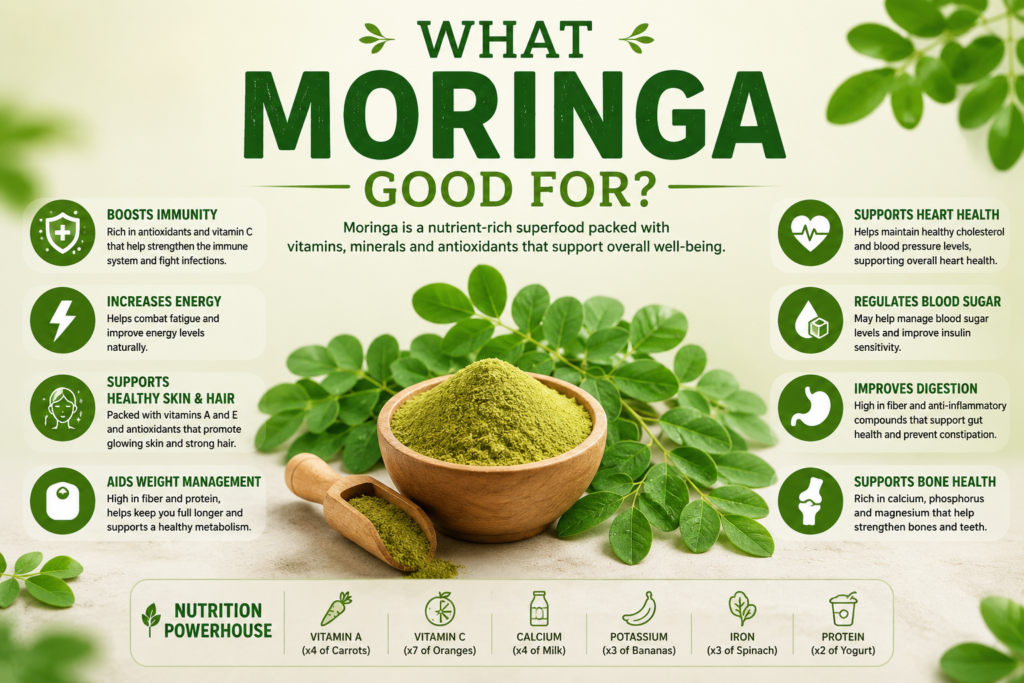
Moringa leaf contains a high concentration of fiber and nutrients that may aid in gut health, metabolism, and daily vitality.
Additionally, moringa leaf possesses bioactive compounds such as tannins, alkaloids, and glycosides that have anti-inflammatory, antioxidant, and antimicrobial activity, which support gastrointestinal protection.
The following section summarizes research studies on diseases including ulcerative colitis, Parkinson’s disease, Alzheimer’s disease, functional constipation, and metabolic syndrome.
Moringa may have a potential beneficial role in the management and prevention of these diseases.
.
Moringa Leaf Powder Benefits for Gut Health and Soothing Ulcerative Colitis
Healthy microorganisms are crucial for digestion and absorption of food in humans and animals.
They also play a role in various biochemical and physiological reactions.
When their population decreases, it can lead to alterations in the normal functioning of the body.
In the intestine, there are millions of microorganisms, which are called gut microbial flora.
These are necessary for the proper and complete digestion of ingested food.
Alteration in the gut microbial flora can be due to various pathological conditions related to the intestine.
Ulcerative colitis is one such disease that may cause alteration in the microbiome.
Ulcerative colitis is a condition that arises due to chronic ulcers in the inner lining of the large intestine and rectum.
Common symptoms include abdominal pain, weight loss, and blood in the stool.
Conventional medications such as sulfasalazine, mesalazine, methotrexate, and glucocorticoids are available for the management of this condition.
However, these medicines also have several side effects.
Occasionally, these side effects are life-threatening.
In recent years, researchers have observed that restoring the gut microbiome concentrations may have a beneficial effect in the management of various diseases.
Herbal medicines derived from plant sources are one of the alternatives to increase healthy microorganisms.
Among herbs, moringa contains various bioactive compounds, micronutrients, and macronutrients.
All these compounds may help promote the proper and healthy functioning of the body.
Hosameldeen Mohamed Husien and colleagues conducted an experiment on the efficiency of Moringa oleifera leaf polysaccharides in improving gut microbial flora in mice.
They randomly selected 45 male BALB/c mice aged seven weeks and divided them into three groups.
The control group received distilled water and sodium chloride.
The experimental groups received dextran sulfate sodium and Moringa oleifera polysaccharides in fixed doses.
The findings suggest that moringa may enhance healthy gut microbial flora in mice.
Moringa can have potential as a supportive treatment in the management of ulcerative colitis.
Moringa leaf polysaccharides may also reduce pathogenic microorganisms.
Moringa Leaf Powder Benefits: A Natural Shield Against Alzheimer’s and Parkinson’s?
There are changes in brain function with age, which can lead to diseases such as Parkinson’s and Alzheimer’s.
Standard medicines are available to manage these conditions.
However, these medicines have certain side effects.
Therefore, researchers have been looking for alternative medications that have higher benefits and minimal side effects.
Ayurvedic medicine has been utilized since ancient times for the treatment of various ailments.
Among herbs, moringa may be utilized for the management of Parkinson’s disease and Alzheimer’s disease.
Elena González-Burgos and colleagues evaluated the neuroprotective effect of Moringa oleifera leaf powder on human cell lines.
They used the human neuroblastoma SH-SY5Y cells for the experimental study.
The cell lines were treated with different concentrations of moringa and exposed to hydrogen peroxide 24 hours after moringa administration.
The results from the nutritional and biochemical analysis indicate that moringa can be used in the management and prevention of oxidative stress.
It may also improve mitochondrial function.
The findings suggest the potential benefit of moringa in combating Parkinson’s and Alzheimer’s diseases
From Blood Pressure to Lipids: Moringa Leaf Powder Benefits for Metabolic Syndrome
Metabolic syndrome is a condition characterized by the presence of a cluster of diseases, such as insulin resistance combined with high blood pressure and obesity.
The condition often requires administration of multiple conventional medicines.
Taking multiple standard medications may be harmful, as it increases the risk of adverse drug interactions and other side effects.
Therefore, researchers are investigating alternative or supportive treatments that may be useful for multiple conditions.
The moringa plant is rich in nutrients and bioactive compounds.
It may be utilized to manage metabolic syndrome.
Marisa Lopez and colleagues conducted a study to determine the efficacy of moringa leaf powder on metabolic syndrome in rats.
They performed both preventive and management studies.
They randomly selected 30 male Wistar rats aged eight weeks and divided them into control, preventive, and experimental groups.
Metabolic syndrome was induced using a high-fat diet and the administration of water supplemented with 10% fructose.
The control group remained without the moringa intervention.
The preventive group consumed moringa leaf powder in a specified concentration for three weeks before the induction of metabolic syndrome.
The treatment group consumed moringa powder for three weeks after the onset of symptoms associated with metabolic syndrome.
The examination of blood pressure and biochemical parameters, such as blood glucose levels, suggests that moringa may have a potential beneficial effect in the management and prevention of metabolic syndrome.
Moringa Leaf Powder Benefits: A Natural Approach to Managing Functional Constipation
Constipation is a very common condition affecting millions of people worldwide.
This condition may be caused by medication side effects, inadequate water intake, and consuming a low-fiber diet.
Conventional medications can be used to manage the condition but may cause side effects such as medication dependency and loose stools.
Therefore, many people have shifted toward herbal products.
Moringa oleifera is one such herb that can be used for the management of constipation, as it is rich in fiber content.
Xiaoyu Gao and colleagues conducted a study on the effect of Moringa oleifera leaf powder on functional constipation in mice.
The researchers randomly selected 72 male C57BL/6J mice aged 6 weeks and divided them into six groups.
The control group received only saline solution, while the experimental groups received a fixed concentration of loperamide and varying concentrations of Moringa oleifera leaf powder aqueous extract for seven days.
The histopathological and biochemical examination revealed the efficiency of Moringa oleifera.
The findings suggest that moringa leaf powder aqueous extract can be used in the management of constipation.
References
1. Husien HM, Rehman SU, Duan Z, Wang M. Effect of Moringa oleifera leaf polysaccharide on the composition of intestinal microbiota in mice with dextran sulfate sodium-induced ulcerative colitis. Front Nutr. 2024;11:1409026
2. González-Burgos E, Ureña-Vacas I, Sánchez M, Gómez-Serranillos MP. Nutritional value of Moringa oleifera Lam. leaf Powder extracts and their neuroprotective effects via antioxidative and mitochondrial regulation. Nutrients. 2021;13(7):2203.
3. López M, Ríos-Silva M, Huerta M, Cárdenas Y, Bricio-Barrios JA, Díaz-Reval MI, et al. Effects of Moringa oleifera leaf powder on metabolic syndrome induced in male Wistar rats: a preliminary study. J Int Med Res. 2018;46(8):3327-3336.
4. Gao X, Yang W, Li S, Liu S, Yang W, Song S, et al. Moringa oleifera leaf alleviates functional constipation via regulating the gut microbiota and the enteric nervous system in mice. Front Microbiol. 2023;14:1315402.
5. Dodiya B, Amin B. Antibacterial activity and phytochemical screening of different parts of Moringa oleifera against selected Gram positive and Gram-negative bacteria. J Pharm Chem Biol Sci. 2015;3(3):421-5.
6. Boateng L, Nyarko R, Asante M, Steiner-Asiedu M. Acceptability of complementary foods that incorporate Moringa oleifera leaf powder among infants and their caregivers. Food Nutr Bull. 2018;39(1):137-48.
7. Yasoob TB, Yu D, Khalid AR, Zhang Z, Zhu X, Saad HM, Hang S. Oral administration of Moringa oleifera leaf powder relieves oxidative stress, modulates mucosal immune response and cecal microbiota after exposure to heat stress in New Zealand White rabbits. J Anim Sci Biotechnol. 2021;12:66.
8. Elabd EMY, Morsy SM, Elmalt HA. Investigating of Moringa oleifera role on gut microbiota composition and inflammation associated with obesity following high fat diet feeding. Open Access Maced J Med Sci. 2018;6(8):1359-64.
FAQ
1. How does Moringa oleifera support gut health?
Moringa may promote growth of healthy microorganisms while decreasing the growth of harmful microorganisms.
Antioxidants and anti-inflammatory compounds present in moringa may also contribute to gut health.
Moringa also contains fibers, which can play a role in managing functional constipation.
2. What is moringin, and why is it important for the intestines?
Moringin is an isothiocyanate.
Its anti-inflammatory and antioxidant properties may play a role in diseases such as ulcerative colitis and irritable bowel syndrome.
It may be used in the management of gut cell barrier damage.
It may act against free radicals and therefore protects gut cells.
It may also enhance the healthy gut-microbiome.
3. What role does quercetin in moringa play in digestive health?
Quercetin possesses antioxidant and anti-inflammatory properties.
It may help neutralize free radical concentrations in the gut and prevent cellular damage in the intestines that typically results from oxidative stress.
4. Can moringa help treat ulcerative colitis (UC)?
Experimental studies conducted on an animal model and in vitro cells reveal that moringa may have potential benefit in ulcerative colitis.
5. Does moringa suppress tumor necrosis factor-alpha (TNF-α) in the colon?
The data obtained from preclinical studies reveal that moringa may have a role in suppressing TNF-α in the colon.
6. Can Moringa reduce the risk of colitis-associated colon damage?
Preclinical studies suggest that moringa may have a beneficial effect in the management of colitis.
.7. Does Moringa help restore colon length lost during active colitis?
Preclinical studies demonstrate that moringa may help retore colon length that shortens during colitis.
8. Can moringa replace prescribed IBD biologics or corticosteroids?
No, moringa cannot replace prescribed medication.
It can be utilized as supportive treatment alongside prescribed medications.
9. Does moringa influence mucosal healing in the colon?
Anti-inflammatory and antioxidant compounds present in moringa may help promote mucosal healing.
10. How does moringa combat intestinal lipid peroxidation?
Excess quantities of free radicals may alter the normal functioning of the gut.
They may damage mucosal cell lining.
Antioxidants and anti-inflammatory substances in moringa may act against these free radicals and may restore the normal gut functioning.
Free radicals are primarily responsible for lipid peroxidation
11. Does moringa protect against drug-induced gut injury (e.g., NSAIDs)?
The data obtained from animal studies indicate that moringa may protect against gut injuries caused by NSAIDs such as aspirin and indomethacin.
12. How does moringa impact intestinal epithelial barrier integrity?
Animal studies indicate that moringa may help protect the intestinal barrier.
Moringa bioactive components protect against tight junction degradation.
Preclinical data indicate that Moringa oleifera leaf polysaccharides may help retain critical tight junction proteins, such as zonula occludens-1 (ZO-1) occludin.
These polysaccharides may protect against structural degradation of intestinal cell proteins that enhances gut permeability.
13. Can Moringa inhibit gut pathogens that exacerbate colitis flares?
Moringa oleifera may be effective against common infective microorganisms such as Escherichia coli and Staphylococcus aureus.
Isothiocyanate and polyphenols like substances in moringa may act as antimicrobial agents.
The property may be helpful in reducing the infective microorganism load in colitis.
14. Does moringa act as a prebiotic?
Bioactive compounds in Moringa oleifera, such as polysaccharides and dietary fibers, modulate the gut microbiota by promoting the growth of beneficial bacteria.
Therefore, we can say that moringa may act as a prebiotic.
15. Does moringa show antimicrobial activity against enteric pathogens?
A number of lab-scale animal studies demonstrated the effectiveness of moringa against enteric pathogens such as E. coli and Salmonella.
16. Does moringa interact with gut medications?
Moringa may interact with gut medications.
Always consult a physician before starting moringa supplements while taking gut medications regularly.

Mr.Piyush D Sadar ,Mpharma B pharma ,Pharma Blog Writer
Medical Disclaimer: This article is for educational purposes only and should not replace professional medical advice. Always consult your obstetrician or healthcare provider before using moringa or any herbal supplement during pregnancy.
Read More :Moringa For Hair Growth