
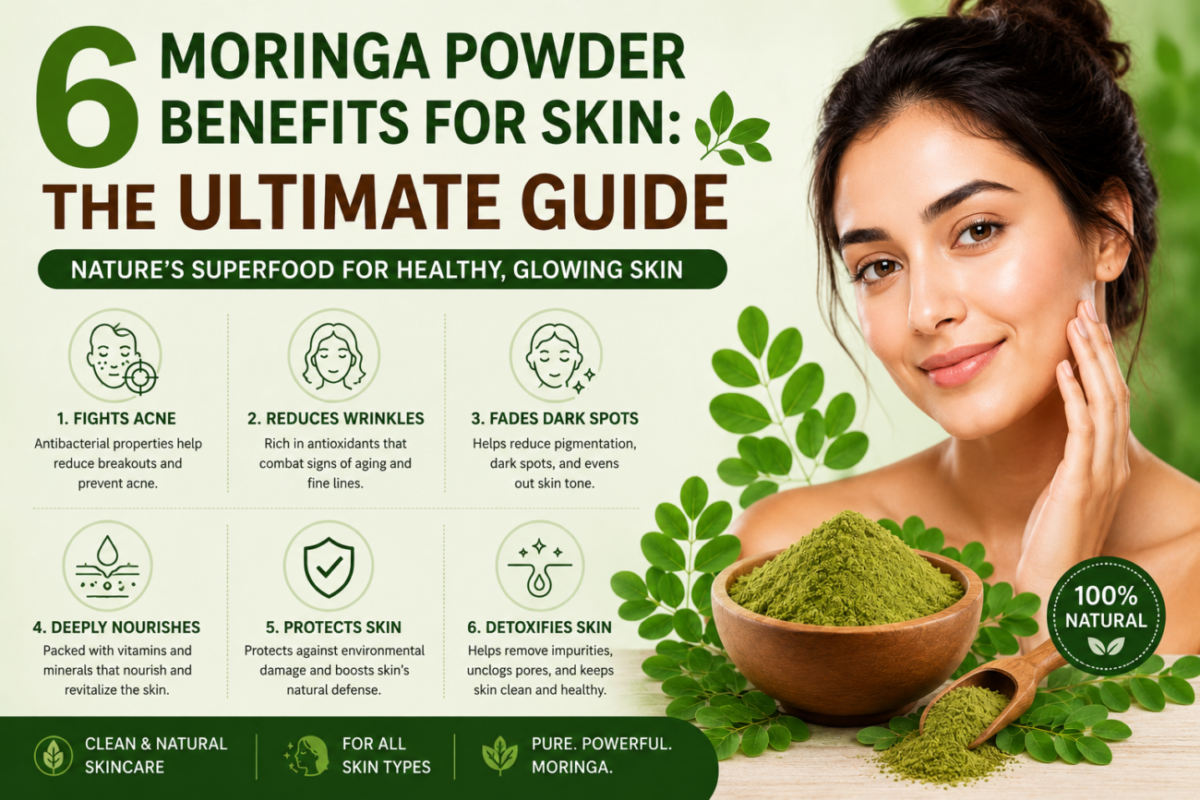
moringa powder benefits for skin :-Since ancient times, the indigenous plant Moringa oleifera has been utilized to manage illnesses and provide various other health benefits.
Today, extensive research demonstrates its efficacy in preventing and treating numerous diseases, as well as its high nutritional value.
Moringa naturally possesses essential nutrients such as vitamin A, vitamin C, and vitamin E and potent compounds, including antioxidants, anti-inflammatory agents, and antibacterial agents.
These compounds can be utilized to treat various skin diseases and general ailments. Furthermore, it can also be utilized for skincare.
The Antimicrobial Benefits of Moringa Leaf Powder
Pathogenic microorganisms enter the human body in various ways; however, consuming contaminated food or eating without prior handwashing is the primary cause of infection.
Improper hand hygiene leads to various respiratory and intestinal infections. Therefore, proper hand washing is essential to eliminating most disease-causing microorganisms.
For centuries, Moringa oleifera has been used for its medicinal values, including its antibacterial effects.
It has been effective against pathogens such as Staphylococcus aureus, Shigella, Bacillus subtilis, Bacillus megaterium, and Pseudomonas aeruginosa.
Belen Torondel et al. conducted an in vivo study to determine the antimicrobial efficacy of Moringa oleifera leaf powder.
The study was performed according to the standard protocol of the European Committee.
Initially, they selected healthy volunteers, who had no skin diseases and had not undergone any recent antimicrobial or other conventional medicinal treatment.
The volunteers’ hands were contaminated with the microorganisms under study.
The researchers performed a comparative study between non-medicated soap and moringa leaf powder.
They applied a specific quantity of non-medicated soap preparations, as well as dry and wet moringa leaf powder in varying concentrations, to volunteers.
The study demonstrated that 4 grams of moringa leaf powder was as effective as non-medicated soap. The antibacterial activity is attributed to natural antibacterial agent present in the plant leaves.
Does Moringa Oleifera Benefit Wound Healing? What Science Says
Although wound healing is a natural process that leads to the restoration of the integrity of cells, typically medications are used for faster recovery.
A wound is defined as the disruption of the cellular, structural, and functional integrity of tissue.
The natural recovering process can be affected by distinct factors, including infections, age, diabetes, stress, and nutritional status.
In traditional Ayurvedic medicine, moringa has been utilized for distinct ailments, including wound healing.
It is a member of the Moringaceae family and has been utilized in different regions of the world for a long time.
It is a prerequisite that the material utilized for wound dressing should be safe and affordable.
Traditional Ayurvedic medicines are both affordable and mostly harmless. Therefore, moringa has been used for wound healing.
To determine moringa’s wound-healing property scientifically, several research studies have been performed.
. Gingival wounds occur due to bacterial infections, trauma from sharp foods, nutritional deficiencies, and dental procedures, often requiring conventional medicinal intervention.
The conventional treatments have several side effects and are often inaccessible to many people. Therefore, researchers are exploring alternative therapies to treat such conditions.
Herbal plants, such as moringa, are rich in nutrients and bioactive agents that can be applied to treat gingival wounds.
Eka Pramudita Ramadhany and colleagues conducted a study on the effect of Moringa oleifera leaf extract on gingival wound healing in rats.
The researchers randomly selected 48 Wistar rats and divided them into control and experimental groups.
The experimental groups received moringa extracts at different concentrations for 7 days.
The study demonstrated that a 15% moringa extract accelerated wound healing.
This healing process was attributed to flavonoids, as well as anti-inflammatory and antibacterial agents present in Moringa oleifera leaves.
Healing Naturally: The Power of Moringa Oleifera Leaf for Diabetic Foot Ulcers
For many people with diabetes, foot ulcers are one of the most frequent complications.
If not treated on time, the patient may require an amputation.Furthermore, treatments for the condition are very costly and may require prolonged hospitalization.
In diabetic individuals, wound healing is a slow process, and frequently, there is a high rate of recurrence. Therefore, such wounds are prone to bacterial infections, which make the condition critical.
Abubakar Amali Muhammad et al. conducted an in vivo study to assess the antibacterial and wound healing activities of the aqueous extract of Moringa oleifera leaves in diabetes-induced animals.
The experiment was conducted on a group of animals divided into experimental and control groups. They applied the aqueous extract of Moringa oleifera in varying concentrations to the affected areas.
From the study it was observed that the aqueous extract of Moringa oleifera had effective antibacterial activity against S. aureus, P. aerugenosa, and E. coli. It was also found to promote wound healing in diabetic animals.
.
Relieving Xerosis Cutis Naturally: The Benefits of Moringa for Type 2 Diabetes
Xerosis cutis is a disorder in which a patient’s skin becomes dry.
It develops when the skin lacks water and there is depletion of natural moisturizing factors, intercellular lipids, and essential oils in the outermost layer of skin.
Common symptoms mainly include rough skin, skin tightness, redness, and pruritus.
Xerosis cutis is one of the common disorders in type 2 diabetes.
While conventional medical therapies are effective in the treatment of conditions, they often have adverse effects.
In contrast, there are several benefits of herbal medicines, including tolerability, low side effects, cost-effectiveness, accessibility in remote areas, and being well accepted by people.
Fitriani et al. conducted an in vivo experiment on patients with xerosis cutis in type 2 diabetes to evaluate the effectiveness of Moringa oleifera cream obtained from leaf extract.
The researchers first identified type 2 diabetes patients with Xerosis cutis.
Both men and women were selected.
Moringa oleifera is rich in fatty acids, vitamin E, and vitamin B that help in the management of the disorder by enhancing hydration and reducing inflammation and irritation.
The study found that a 3% Moringa oleifera leaf extract cream effectively decreased the severity of Xerosis cutis in type 2 diabetes.
The Miracle Tree: Can Moringa Oleifera benefit Your Skin from UV Damage?
Direct exposure to UV rays emitted by the sun can cause short-term ailments such as sunburns, tanning, and localized skin immune suppression and long-term effects such as skin cancer, premature aging, and DNA damage.
To prevent these adverse effects, it is essential to apply sunscreen regularly on the skin.
Conventional sunscreen products are effective at reducing the UV rays’ adverse effects, but they may have side effects.
In contrast, herbal products have several benefits, including a low risk of skin irritation, high biocompatibility, relative safety, and protection against hormonal disruption.
Furthermore, they also possess antioxidant and anti-inflammatory properties.
Nining Sugihartini et al. conducted an evaluation of Moringa oleifera extract and its cream and gel formulations as sunscreen agents.
The researchers first extracted the active constituent from moringa leaf powder.
Moringa is rich in quercetin, chlorogenic acid, vitamin C, vitamin E, and beta-carotene, which can be used as natural antioxidants.
The formulations were subjected to physical and chemical evaluation.
From the study, it was observed that moringa leaf extract has an SPF value of 33.5, which indicates strong sunscreen properties.
The Anti-Aging Benefits of Moringa Oleifera Leaf
The production of free radicals in the human body is a natural process.
These are mainly produced in two ways. a) endogenous sources b) exogenous sources.
Endogenous free radicals are generated by processes that mainly include cellular metabolism, immune system functioning, inflammation processes, and enzymatic reactions, while exogenous contributing factors are environmental pollutants, radiation, alcohol, smoking, heavy meals, and drugs.
Although free radicals play an essential role in cellular signaling and immune system functioning, they also have harmful effects such as cell damage, aging, and DNA damage.
To counteract such harmful free radicals, antioxidants present in the human body play a role.
Antioxidants mainly interact with free radicals and stabilize them by donating electrons, ultimately interrupting the destructive chain reaction.
Masita Imamsari et al. conducted an in vivo study to evaluate the antiaging activity of Moringa oleifera leaf extract.
For the experimental study, researchers used a specific number of Mus musculus Swiss Webster mice.
For the extraction of bioactive compounds, they used three distinct solvents.
From the experimental result, it was observed that Moringa oleifera leaf extract has effective antiaging activity in mice’s skin.
References:
1. Torondel B, Opare D, Brandberg B, Cobb E, Cairncross S. Efficacy of Moringa oleifera leaf powder as a hand-washing product: a crossover controlled study among healthy volunteers. BMC Complement Altern Med. 2014 Feb 14;14:57. Read
2. Ramadhany EP, Ambarawati IGAD, Musyaffa MR. Effect of 4% and 15% moringa leaf extract gel on gingival wound healing in rats. Maj Kedokt Gigi Ind. 2022;8(3):192-199.
3. Muhammad AA, Fakurazi S, Arulselvan P, et al. Evaluation of wound healing properties of bioactive aqueous fraction from Moringa oleifera Lam. on an experimentally induced diabetic animal model. Drug Des Devel Ther. 2016 May 24;10:1715-1730.
4. Fitriani, Setiawan I, Purwoko MIH, Bahar E, Shiyan S, Kartowigno S, et al. Efficacy of 3% Moringa oleifera Lam. leaf extract cream in improving xerosis cutis in patients with type 2 diabetes mellitus. J Pak Assoc Dermatol. 2025 Jul-Sep;35(3):234-241.
5. Sugihartini N, Fajri MA, Rahmawati DR. Formulation of Moringa oleifera leaf extract in lotion and gel as sunscreen. Int J Appl Pharm. 2021;13(2):154-158.
6. Imamsari M, Pertiwi-Koentjoro M, Nurhayati AP, et al. In vivo preliminary examination of Moringa oleifera leaves extract as an anti-aging candidate in Swiss Webster male mice (Mus musculus). AIP Conf Proc 2018;2000(1):020015.
FAQ
Yes, moringa is a rich source of vitamin C, vitamin A, vitamin E and zinc.
These nutrients may protect skin and scalp health through anti-inflammatory, antioxidant, and antimicrobial activities.For more science-backed health guides and educational resources, visit us at https://buymoringapowder.com.
Nutrient-dense moringa oil provides distinct benefits.
A high concentration of oleic acid acts as a moisturizing agent. Vitamins A, C, and E act as antioxidants, thus protecting skin from free radicals and damage from atmospheric pollutants.
Additionally, its antibacterial characteristics help to treat various infectious conditions.
Nutrients present in moringa protect the skin and manage skin aging.
Its antioxidants interact with and neutralize free radicals, protecting the skin tissues from oxidative damage caused by atmospheric pollutants and UV rays.
Vitamin A plays a role in collagen production and thus maintains healthy skin.
Additionally, oleic acid in moringa prevents skin dryness and maintains moisture.
It acts as a protective barrier and maintains skin elasticity by blocking enzymes such as elastase, hyaluronidase, and collagenase, thereby helping to manage skin aging.
Yes, moringa contains zinc, which regulates sebum production and prevents clogged pores.
Although moringa does not generally cause skin rashes, it may cause allergic reactions in individuals with known plant allergies.
Therefore, performing a patch test is recommended before use to evaluate for any skin reactions.
Yes, scientific studies demonstrate that moringa leaves are packed with nutrients and bioactive compounds that protect the skin.
Yes, moringa is a rich source of vitamins that provide health benefits for the skin.
Moringa is rich in antioxidants, flavonoids, antibacterial compounds, and vitamin K, which can help accelerate wound healing.
Yes, moringa leaves possess natural antimicrobial agents, which can be categorized as flavonoids, phenols, isothiocyanates, tannins, and saponins.
Yes, scientific studies demonstrate the efficacy of Moringa oleifera in skin tissue regeneration.
Yes, moringa can be utilized to improve skin tone and complexion.
It can either be consumed as a complementary dietary supplement or applied topically as a face mask.
Yes, scientific studies have evaluated the efficacy of moringa to manage conditions such as acne, eczema, and psoriasis. Anti-inflammatory, antibacterial, and other bioactive compounds in moringa can reduce symptoms associated with skin diseases.
Scientific literature suggests that Moringa oleifera has the potential to heal mouth ulcers and wounds inside the mouth
Yes, various bioactive components found in moringa leaves help to manage this condition.
Yes, it can be paired with other ingredients like aloe-vera, honey, hyaluronic acid, and shea butter.

Mr.Piyush D Sadar ,Mpharma B pharma ,Pharma Blog Writer
Medical Disclaimer: This article is for educational purposes only and should not replace professional medical advice. Always consult your obstetrician or healthcare provider before using moringa or any herbal supplement during pregnancy.
Good content keep posting